Monday, August 28, 2006

Only the King County "Developers" Journal would give a "Thumbs up for approval of Redmond Ridge"

Never mind that "Redmond Ridge" was approved in 1997 and the paper's grovelling to Quadrant couldn't even get the name of the development, "Redmond Ridge East", correct. What do you expect from a newspaper that simply reprints county and developer press releases, but has no interest in the facts, investigation, or even quotes from outsiders who might counter the government/developer spin on all of this? I've got to wonder what motivates a paper to work so hard to help condone what every informed person knew was anything but worthy of praise. But this is nothing new for this Horvitz-owned newspaper.

The paper's lead editorial today, "Thumbs up for approval of Redmond Ridge" is just the finishing touch by a paper that long-ago won the title as the King County "Developers" Journal. It's bad enough that the paper's coverage of Redmond Ridge East was little more than cheerleading for Quadrant Homes, but leave it to this paper to work the PR a week after the County Council ignored the law and efforts by the opposition that proved that DOT had cheated - again - for this developer and improperly issued them a concurrency certificate that was the basis of its approval by the county's development machine.

You'll probably never see the following letter printed in the paper, so here it is for readers of my blog:
Re: Thumbs up for approval of Redmond Ridge?

In 2002, King County DOT granted Quadrant Homes a transportation concurrency certificate for Redmond Ridge East (RRE) even though Novelty Hill Road was already operating over capacity with thousands of Redmond Ridge and Trilogy homes yet to be constructed,. The infamous 10-year old CIP project for Novelty Hill Road had again been emptied of funding, and still had no plan, EIS or approval. CIP #100992 still has no EIS, plan, approval, or full funding today.

Fivc county DOT employees went public in 2003 with a laundry list of allegations, including both improper and illegal acts committed by the DOT concurrency group for RRE. They alleged that they were retaliated against for their charges by their management, including DOT director Linda Dougherty, after their names were linked to decisions they did not make and they were demoted.

Then in 2005, in an unprecedented ruling, the King County hearing examiner agreed that DOT had cheated and recommended denial of RRE and the rescinding of its wrongfully issued concurrency certificate.

None of this mattered last week when a decade of DOT corruption concluded and the County Council, with the exception of Kathy Lambert, voted to ignore the wrongdoing, concurrency laws, and approved RRE anyway.

Yeah, this is certainly something for a newspaper to condone. But as usual, the King County "Developers" Journal has always made its allegiance to the growth industries very clear. If only it focused as much attention on investigative journalism and not reprinting county and Quadrant press releases?
"Land use process in King County." There's a laugh! "Unbiased coverage of land use decisions by the King County Journal." That's even funnier!

Thursday, August 24, 2006

The utter futility of opposing land use decisions in King County

I wanted to make one more comment about land use decisions in King County.

In 1994, virtually every citizen in the Bear Creek area knew that King County was full of it when they claimed that Novelty Hill Road could handle cars from 3,650 homes and a 1.7 million square foot business park, commercial and retail area. But in 1994, no one probably imagined the extent to which their government would cheat for a developer.

It wasn't until after Redmond Ridge and Trilogy had been approved in 1997 that one citizen decided to investigate whether the county had done an honest analysis of concurrency or not. And when this person discovered that the county hadn't even included the study in the record for Redmond Ridge or Trilogy, he knew something was going on that smelled really bad.

Only through Public Disclosure Requests and his willingness to go down to KCDOT and sort through boxes of unsorted materials related to the traffic study, the analysis - as best it could be put together - was revealed. That review of the analysis revealed nothing but distortions, unreasonable assumptions, and bogus data at every turn. If you want to call them "mistakes", every single mistake benefitted the development and the developer. Not a single mistake could be found that benefitted the communities that these projects have forever altered.

They were not mistakes!

It was too late to use this information to halt Redmond Ridge and Trilogy, because Ron Sims and KCDOT had no interest in reopening hearings or even correcting the data. Sims refused a Supplemental EIS and helped DOT cover-up its fatally flawed analysis by allowing them an eqaully flawed "do over" that the public was not allowed to even comment on. Those two projects exist today despite the only official traffic study being totally discredited by Sims himself in 1998, but never replaced with an honest one.

So this knowledge of how DOT "cooked the books" for developers was shared with other opponents of other irresponsible development, primarily on the Sammamish Plateau. In one instance, the data actually helped guide a paid consultant into convincing the hearing examiner that KCDOT had cheated for that developer. A settlement was reached in that instance, but ultimately the Sammamish Plateau incorporated itself; freeing itself from the county's regular "bait and switch" dollar flipping techniques used in the county's CIP projects.

Thousands of permits, many of them alleged to have been granted by King County using similar "arbitrary and capricious" means, were protected by the newly elected city council. Their elections occurred in a very ugly election where the builders on the Plateau worked to keep their county-approved permits in place. With the defeat of every one of the candidates interested in responsible growth, including review of the county's previous actions, the new city of Sammamish imposed a moritorium on new development. But no one can claim to recognize the existence of that moritorium given the non-stop construction in Sammamish since incorporation, based primarily on those thousands of county-approved permits. The roads are slowly being improved in Sammamish as the city's elected leaders focus on Sammamish and are held accountable by its voters.

King County learned a long time ago that by funding a critical road project in the 6-year CIP, they could approve a development despite the lack of capacity in the road network to support it. As soon as that development was approved, they could then yank those dollars out of the related road project and apply them to the next road project needed to justify the next development. The technique is one of most significant reasons growth has outpaced roads in King County, and it is a tactic that is still being used today.

That strategy was used with Redmond Ridge and Trilogy. CIP #100992 entered the books in 1992 to widen Novelty Hill Road and provide the capacity needed to support these two developments. But that project never happened. It still hasn't happened yet in 2006, but the same old game was played again in 2002 when Quadrant applied for a new 800-home development called Redmond Ridge East. The same CIP was used to justify Redmond Ridge East, and even though it still doesn't have a plan, EIS, full funding or approval, it is capacity on the books that DOT has given Quadrant.

The difference with Redmond Ridge East was that the opposition was onto both the tricks used by KCDOT, and the department's willingness to invent, distort, corrupt and cheat wherever needed to help Quadrant again. This time there were also DOT employees within the TFDM group that also stood up and objected to what the DOT concurrency group was doing. Through a series of alleged actions by DOT supervisors against these "whistleblowers", including DOT director Linda Dougherty as described in a Seattle Times, July 2005 article below, the objectors were removed from any involvement in the matter so Redmond Ridge East could get its concurrency certificate.
"Dougherty and Lindwall say that under a law that protects public employees, they should be given immunity in this case because they did not know they were violating anyone's civil rights by excluding Barahimi and Chen from meetings, putting their names to decisions they did not make, hiring an outside consultant to redo their work or by demoting them."
But in the public hearings for Redmond Ridge East in 2005, something truly miraculous occurred. With the knowledge of the Redmond Ridge and Trilogy manipulation, and with the help of the whistleblowers, the KCDOT concurrency group's analysis was ripped to shreds. So much so that the King County Hearing Examiner recommended denial of the application and rescinding of its ill-gotten concurrency certificate.

Last week the King County Council completely ignored that long fought battle and the examiner's findings. The recommendations were both ignored and the King County Council gave Quadrant its approval for Redmond Ridge East. The county called it phased, but with hundreds of homes approved before Quadrant has to do much of anything, it was just another wholesale sellout by the County Council.

A fight like this will likely never happen again in King County. Why would anyone attempt it? It started over a decade ago here, and if one lesson has been learned it is that in this county the entire land use process is only for show. Republicans and Democrats in leadership, with the possible exception of Kathy Lambert today, couldn't care less about concurrency, fairness, retaliation against employees, or certainly the communities they've sworn an oath to protect.

So with this said, I'll probably not talk about concurrency or land use in King County again (at least for a while). The reality I've come to accept is that there has never been a concurrency policy in King County, except perhaps for DOT to find ways to subvert it. The land use process in King County is nothing but a facade to suggest to the people that a process exists and big developers like Quadrant don't run the county's development machine. The truth is that for certain developers, the process works to simply drive out opposition so King County can give their friends in the industries of growth everything they wanted from the start.

A fantastic example of the collusion between the county and developers like Quadrant occurred last month, when Quadrant's lawyer Richard Wilson, was authroized to speak on behalf of King County's DOT and DDES in the Redmond Ridge East appeal hearing. The visual was so very appropriate, as Wilson argued the unfairness to Quadrant should Redmond Ridge East be denied, while speaking for Quadrant and for two King County agencies that are supposed to represent the interests of county citizens and the communities being overwhelmed by growth.

That's it. Thanks for reading.

Tuesday, August 22, 2006

King County Council ignores CONcurrency again

If anyone still believes that King County cares about supporting growth with roads, yesterday's approval of Redmond Ridge East should drive the last nail in that thinking. If anyone still thinks that this county council cares about hearing examiner recommendations to deny development, or that they might be concerned with the ongoing wrongdoing by KCDOT to cheat for developers, the decision should quickly erase that too.

Yesterday's approval of Redmond Ridge East, on an 8-1 vote, is the clearest evidence to date that King County's land use machine is controlled by big developers like Quadrant, and that anything is okay when it comes to actions to help developers like Quadrant get projects approved; even if it means millions in unfunded road impacts and gridlock for citizens.

With more than 1500 homes yet to be constructed within the long-approved Trilogy, road congestion has blossomed into miles of AM and PM commute traffic along Novelty Hill Road. But with the county's traditional "bait and switch" approach to its Capital Improvment Program, this 14 year-old CIP item is still unplanned, unfunded, and unapproved. But that doesn't matter to a county that would and has literally been alleged to have broken laws to help this developer get 800 more homes approved.

With DOT whistleblowers suing the county over wrongdoing and retaliation, and hundreds of millions of dollars in road impacts buried and passed onto future taxpayers to address, the Council's approval of Redmond Ridge East, in the face of hearing examiner Stafford Smith's recommendation to deny the project and rescind it concurrency certificate, is the final proof that there is nothing this government will not do for Quadrant.

The King County Council clearly felt more than comfortable ignoring the examiner's finding once there were no appellents left with standing to sue. Never mind what was the right thing to do, huh?

And with its allies in the Seattle Times and King County Journal giving this outrageous violation of the public trust cover, most people will continue to ask, "why aren't our roads being improved to support growth?" For those watching this fiasco, the answer is obvious.

Tuesday, August 15, 2006

Audit of King County Concurrency System backs critics' allegations

On July 10, the King County Committee of the Whole was presented the results of the 2-year audit of the King County Department of Transportation Road Services Division, and specifically its concurrency program designed to support new development with the necessary road infrastructure. The conclusions align with more than a decade of allegations and charges made by critics of King County DOT and its actions on behalf of certain developers.

Among the findings made by Tom Noguchi of Mirai Transportation and Planning were the following, based on two of the questions asked by the King County Council in 2004 to be answered by the audit:

Is the concurrency model documented and consistent with best practices?

Answer: "No, we found many problems.
- Concurrency models overly complex
- Quality control is poor
- Many technical assumptions have not been documented and presented to Council
- Modeling techniques are not consistent with standard practices and do not reflect driver behaviors
- Traffic congestion as measured by the model was significantly reduced in 2004 - not true based on our experience
- Road Services staff could not explain the reason for this change"

Does King County's base transportation model used for transportation planning employ best practices for transportation modeling?

Answer: "Yes, it is generally sound"

The "base transportation model" is created by the Transportation Forecast Data Management group (TFDM). The Concurrency Group then takes this base model and modifies it to reflect current and future development and road projects before determining whether a new development application meets concurrency or not. A development application cannot even be considered unless it has obtained a concurrency certificate issued by the concurrency group, so the importance of the concurrency group's modeling methods and integrity, in support of county standards, is of paramount importance.

As a result of a concurrency certificate issued to Weyerhaeuser in 2002 for Redmond Ridge East, and after all their efforts had failed to have their concerns addressed within KCDOT, five (5) employees within the KCDOT TFDM group, including its supervisor, filed a whistleblower complaint in 2003 alleging improper and possible illegal acts committed by the Concurrency Group to help Weyerhaeuser improperly obtain that Redmond Ridge East traffic concurrency certificate. They have since filed, and the case is currently pending, a lawsuit in Federal Court alleging, among other things, retaliation by their management and DOT Director Linda Doherty, because they would not go along with what they believed were indefensible actions and decisions being made in support of Redmond Ridge East.

The TFDM's allegations were affirmed in 2005 when King County Hearing Examiner Stafford Smith ruled that the concurrency group had engaged in at least 3 instances of "arbitrary and capricious" actions that helped Redmond Ridge East, but that could not be adequately explained or justified. Smith's recommendation to the County Council as a result of the Redmond Ridge East hearings was to deny Redmond Ridge East and to rescind the traffic concurrency certificate issued in 2002.

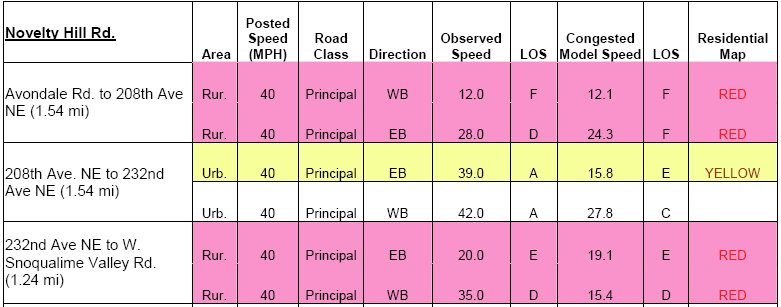
The table below shows the current status of Novelty Hill Road with hundreds of homes yet to be constructed in Trilogy and before approval of Redmond Ridge East. With an average westbound speed of just 12 mph and a LOS F score (for Failing), what this shows is King County's determination to not let anything deter it from helping Quadrant/Weyerhaeuser. With Novelty Hill Road RED and failing both east and west of Redmond Ridge and Trilogy, can anyone defend KCDOT's claims that 800 more homes can be supported?


Redmond Ridge East is an 800-home development under Council consideration today adjacent to the eastern boundary of Redmond Ridge. With the only citizen opposition group, Friends of the Law, settling with Quadrant after the appeal window had closed, the King County Council appears ready to forgive all the wrongdoing and allow Redmond Ridge East to move forward in phases, again awarding Quadrant the ability to construct hundreds of additional homes before critical road infrastructure is planned, studied, funded or approved.

The auditor's findings support allegations made by citizens opposing Redmond Ridge, Trilogy, and now Redmond Ridge East going back a decade. Those charges have consistently alleged that the DOT concurrency group has been "cooking the books" to assist Quadrant Homes win approval of massive developments, without the concurrency group identifying the adverse impacts, or Quadrant funding the necessary road improvements within King County, surrounding cities, or to state-funded highways.

As usual, King County is interested in only looking forward. The Council's plan for Redmond Ridge East, presented by Dow Constantine in the appeal hearing last month, again makes empty promises to fix the traffic mess along Novelty Hill and Avondale roads. It awards Quadrant with hundreds of additional permits for doing virtually nothing and before any of the needed improvements to Novelty Hill Road have even been approved. It also ignores the "arbitrary and capricious" actions committed by county planners and their management whose acts have allowed an application to be considered that should never have received a concurrency certificate in the first place.

The presentation can be viewed at about 1 hour 11 minutes into the following archived video:
rtsp://media01.metrokc.gov:554/CouncilArchive/cow/COW20060710.rm

Or at http://www.metrokc.gov/CTV/Archive/index.htm
Scroll down to "Committee of the Whole" on the main page and click the link for July 10, 2006. Again, the audit preseentation starts at about 1 hour 11 minutes into the video

If you're intereseted in the Audit Presentation Click Here

If you're interested in the Detailed Audit Report Click Here

Monday, August 14, 2006

King County CONcurrency - How much development can it support with one unbuilt road project?

In 1992, King County added CIP#100992 to its Capital Improvement Program to widen Novelty Hill Road. As the years passed, mega-developments like Redmond Ridge and Trilogy were approved, constructed, and traffic congestion grew into miles of backups in the morning commute. But CIP#100992 still hasn't been built. Why? Dollars have flowed into this CIP over the years, and the dollars have flowed out of it, as millions were spent on design, ROW acquistion, and little else, other than maintaining this project as justification for thousands of trips in capacity on a roadway that is still primarily 2 lanes between Redmond Ridge and Redmond.

We're not talking about small change either. The CIP peaked in 2001 at nearly $90 million. That was up from $17.5 million the year before, and $46 million a year after. Today, after spending more than $9 million to date, King County still doesn't have a plan, an EIS, funding, or contracts signed for construction. That $9 million has fallen down a whole never to be seen again, while the County now uses this CIP project to justify another development, Redmond Ridge East.

In fact, the construction years for this "poster child" for delayed CIP projects was once in the last decade. It slid a decade ago from the last century into this century. Construction was set for 2005 in 2000, 2006 in the 2001 CIP, and today it alleges to "fully fund" construction for 2009. In all likelihood, though, if we see anything before 2011 it will probably shock even the DOT planners.

Amazingly, today CIP#100992 has shrunk to a $20 million construction project in the CIP, on top of dollars already spent and future design and ROW acquisition, despite past studies that estimated it at 3 to 4 times that amount. But none of this really matters, because King County never needs to widen Novelty Hill Road. The dirty little secret, and the strategy that drove Sammamish to incorporate, is that King County doesn't needs roads to approve development for its friends with Weyerhaeuser, but all it needs is a line-item in the CIP with some imaginary dollars attached.

The not-so secret technique that King County has used for decades to approve development without building roads is well known to victims of King County's growth agenda. We've all seen it, but recently I received a letter from Assistant Cheif Civil Deputy Kevin Wright in the Prosecuting Attorney's Office that spells it right out as clear as can be. How can King County use unbuilt road projects to defend its decisions to approve development?

Here's the answer in Kevin Wright's own words:
By Code, the status of any construction contracts and any environmental review associated with a road improvement included in the County's CIP is not relevant to whether the road improvement will be considered to be completed "concurrent with development." The Code provides that road projects that are fully funded in the County's six-year CIP are included in the road network (referred to as the "committed network") used to measure concurrency. KCC.14.70.210(E)

So here is the mystery solved. King County puts money into the CIP for a road project and the law allows them to use the unbuilt capacity from the project to justify more growth. King County just calls the project "complete" when some funding appears in the CIP and they've satisfied the Growth Management Act's concurrency regulations. Whether the county has a design for the project is irrelevant. Whehter the project has a completed EIS is irrelevant. Whether the project is really fully funded is irrelevent. And whether any contracts have been issued for construction is completely irrelevant.

In reality, nothing is relevant in King County except keeping developers like Quadrant satisfied. If that means using the same unbuilt CIP project for 14 years to allow 5,000 homes, a business park, commercial and retail construction, so what?

That's why it's called CONcurrency. And as long as the citizens of King County continue to fall for it, our road network will not improve, growth will not be supported with infrastructure, and demands on the people to raise their taxes to subsidize the growth industry's profits will only increase.