No. Adjusting for inflation, the price of gas is nowhere close to it's all-time high in 1980.
In 1980, gasoline prices reached $1.35 per gallon. Now while that seems like nervana compared to the national gasoline price per gallon of $2.55 in the United States today, if adjusted for inflation since 1980, the current price of gas is just $0.95 a gallon in 1980 dollars.
If the price of gas reaches $3.64 a gallon anytime soon, then Americans will really have something to complain about. That is the price per gallon in 2006 that will equate to $1.35 in 1980.
Wednesday, March 29, 2006


Friday, March 24, 2006
The importance of adjusting for inflation in comparing today to yesterday
Since the value of the dollar is the measurement of everything from GDP to revenues and outlays, adjusting for inflation is the only way to understand the real growth of government. In simplest terms, if you adjust for inflation and then for population growth, the result should reflect the actual growth or reduction in growth of government. Given the US population in 1980 of ~230 million and today's ~300 million, one could justify a growth of government to support additional Americans, albiet some of this growth can be attributed to illegal immigration. So after inflation, growth of government of 30% for population growth would be reasonable, but what is the actual growth of the federal government?
First something about the numbers provided by the government. If they are not adjusted for inflation, they cannot be compared to other years. The affect of inflation on us is not trivial. For example, $100 dollars today buys only what $37 would have purchased in 1980. So if it takes nearly $3 to buy what $1 did in 1980, then to compare anything today to 1980, the numbers must be adjusted for inflation so they can be compared. In another example, my entry-level job in 1984 would have to offer double that salary today to be equal to what I earned 22 years ago.
First let's look at the GDP growth rates for the last 4 administrations (adjusted for inflation):
(1982-1989*)
GDP increased under Ronald Reagan at a 3.4% annual growth rate.
(1990-1993*)
GDP increased under George H. W. Bush 41 at a pathetic 0.6% annual growth rate.
(1994-2001*)
GDP increased under Bill Clinton at a 2.7% annual growth rate.
(2002-2005*)
GDP increased under George W. Bush at a 2.95% annual growth rate.
*Dates reflect periods impacted by economic policies.
So now let's consider what the government is spending today versus the growth rate of the US GDP.
After adjusting for inflation, the Gross Domestic Product in the US has increased 77% since 1980. In unadjusted dollars it looks far more impressive at around 360%, but that's not a realistic comparison. Today's dollar is only worth 37% of what the 1980 dollar was worth.
So in 25 years GDP is up 77%, well outpacing population growth by 47%. Thats great news about our economy.
In the same 25 years Social Spending is up 102%, and its growth rate is increasing. Social Spending growth has also outpaced population growth by 72%. That's bad news and getting worse every year.
National Defense has increased only 49%, or well below the rate of GDP growth, while it has outpaced population growth by 19% during the same period. But given that we are at war against terrorism and trying to make up for decades of ignoring our security, I have no complaints that Bush is spending now to protect us and our children.
Physical investment in transportation, Energy, natural resources and the environment, as well as community and regional development is down compared to 1980. Here is one of the consequences of social spending growth; no money to build anything like we once did. The crisis in transportation in Western Washington can be directly linked to the federal government's shifting of dollars away from physical investment to social investment.
And then, just when you might say, "this isn't so bad", here is the future Democrats are fighting to preserve with no trust funds available to make up even a portion of the gap when outlays exceed revenues in 2015:
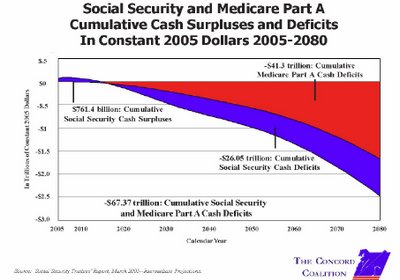
If you can't read those numbers in the chart? They show a $26 TRILLION shortfall for Social Security and a whopping $41.3 TRILLION deficit for Medicare Part A between now and 2080. Also note that while both programs go into the Red in around 2015, those empty trust funds will be exposed for the empty buckets of nothing that they are. But by then the trillions stolen and spent on other government spending will be gone with nothing else to make up the shortfall.
So I'll raise the question posed in an earlier post again. Are the Democrats refusing to reform social spending for purely political reasons, or along with many Republicans do both parties acknowledge in secret that nothing can be done to avoid this train wreck?
First something about the numbers provided by the government. If they are not adjusted for inflation, they cannot be compared to other years. The affect of inflation on us is not trivial. For example, $100 dollars today buys only what $37 would have purchased in 1980. So if it takes nearly $3 to buy what $1 did in 1980, then to compare anything today to 1980, the numbers must be adjusted for inflation so they can be compared. In another example, my entry-level job in 1984 would have to offer double that salary today to be equal to what I earned 22 years ago.
First let's look at the GDP growth rates for the last 4 administrations (adjusted for inflation):
(1982-1989*)
GDP increased under Ronald Reagan at a 3.4% annual growth rate.
(1990-1993*)
GDP increased under George H. W. Bush 41 at a pathetic 0.6% annual growth rate.
(1994-2001*)
GDP increased under Bill Clinton at a 2.7% annual growth rate.
(2002-2005*)
GDP increased under George W. Bush at a 2.95% annual growth rate.
*Dates reflect periods impacted by economic policies.
So now let's consider what the government is spending today versus the growth rate of the US GDP.
After adjusting for inflation, the Gross Domestic Product in the US has increased 77% since 1980. In unadjusted dollars it looks far more impressive at around 360%, but that's not a realistic comparison. Today's dollar is only worth 37% of what the 1980 dollar was worth.
So in 25 years GDP is up 77%, well outpacing population growth by 47%. Thats great news about our economy.
In the same 25 years Social Spending is up 102%, and its growth rate is increasing. Social Spending growth has also outpaced population growth by 72%. That's bad news and getting worse every year.
National Defense has increased only 49%, or well below the rate of GDP growth, while it has outpaced population growth by 19% during the same period. But given that we are at war against terrorism and trying to make up for decades of ignoring our security, I have no complaints that Bush is spending now to protect us and our children.
Physical investment in transportation, Energy, natural resources and the environment, as well as community and regional development is down compared to 1980. Here is one of the consequences of social spending growth; no money to build anything like we once did. The crisis in transportation in Western Washington can be directly linked to the federal government's shifting of dollars away from physical investment to social investment.
And then, just when you might say, "this isn't so bad", here is the future Democrats are fighting to preserve with no trust funds available to make up even a portion of the gap when outlays exceed revenues in 2015:
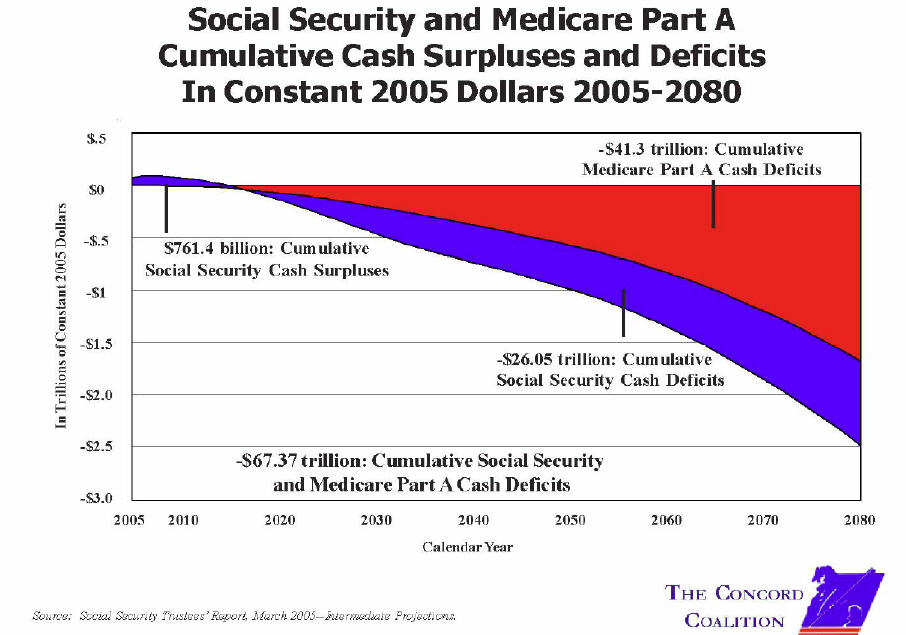
If you can't read those numbers in the chart? They show a $26 TRILLION shortfall for Social Security and a whopping $41.3 TRILLION deficit for Medicare Part A between now and 2080. Also note that while both programs go into the Red in around 2015, those empty trust funds will be exposed for the empty buckets of nothing that they are. But by then the trillions stolen and spent on other government spending will be gone with nothing else to make up the shortfall.
So I'll raise the question posed in an earlier post again. Are the Democrats refusing to reform social spending for purely political reasons, or along with many Republicans do both parties acknowledge in secret that nothing can be done to avoid this train wreck?
Monday, March 20, 2006
Federal trust funds being stolen and spent by government - Is government avoiding problem because it's too late to fix?
If people knew a catastophe was about to occur, I think it's assumed that most people would fight to avoid it. Like a crack appearing in a major dam, or a missing section of railroad track, people would rush to fix the problem and avoid the disaster. So is the case, I would hope, for governmental programs that are destined to end in crisis, even if only an economic crisis. Once the flaw is exposed, legislators would rush to repair the flaw and avoid the crisis. But what should people think when such an obvious flaw is apparent in a massive government program, and government won't fix it? What should we think when the flaw was put their by design?
For decades social spending in America has been on the rise. The bulk of that spending is in what are called entitlement programs, such as Social Security, Medicare, and Welfare. Through adjustments in taxation and outlays, government has funded these programs even though fewer Americans support what is a growing number of Americans who are recipients. Since the 1980s, through the use of taxation that produces revenues that exceed outlays, these surpluses have been placed into what the government calls trust funds. These funds are advertised by the government as ready to be used to make up the difference when population demographics increase the percentage of Americans on the receiving end of these benefits to levels unsupportable by working Americans pay into the plans. In simpler terms, pay the benefits to the baby boomers when taxes can't support benefit payments.
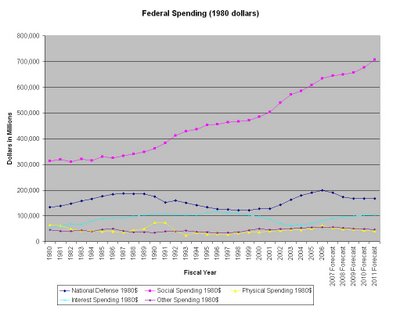 The graph above depicts United States government spending since 1980. It is adjusted for inflation and shown in 1980 dollars, so it represents the real growth of the major parts of the government:
The National Debt currently stands at around $8.27 trilllion dollars, or about $27,500 for every man, woman and child in America. $3.47 trillion of that debt is currently held by the government in the form or Treasury securities. Of that, roughly $2 trillion is what the government alleges makes up the Social Security and Medicare trust funds. Those trust funds represent the security net for America when the boomers begin retiring and government revenues are inadequate to fund their benefits.
What would we do without those trust funds? Well, we're going to find out because they don't exist. And if we don't do something right away, another $3 trillion is going to be stolen and spent by this government only making things worse.
So what is the trust fund? Simply, it's the jar under the bed filled with the IOUs the government has put in it after it has borrowed and spent the money. Yup, the surpluses are gone. They've been spent. The government has borrowed $3.47 trillion dollars from overtaxed Americans and spent it to artificially lower annual deficits and fund unfunded spending.
Imagine that you plan to buy a car in 5 years, but you don't trust banks. You decide to put $100 a week into a jar under the bed, assuming that in 5 years you'll have $26,000 for that new car. After the first couple of months you look at that jar and see those hundred dollar bills and you have this great idea. What if you borrow the money from the jar and replace it with a $100 IOU each week. You can party, eat out, do whatever you want with the money because that jar will still have the savings for your new car in 5 years.
At the end of that 5 years, what do you have in that jar? Because you borrowed the money from yourself, you are liable to repay the jar. Basically, the money is gone! And there is the government trust fund program in a nutshell. The government has borrowed $3.47 trillion from itself and spent it. That's $2 trillion from Social Security and Medicare that is now gone.
So what will the government have in the trust fund in 2015 when entitlement outlays exceed revenues? What will the government do when there are no other surpluses to steal to fund the entitlements?
So why won't the government fix this? President Bush has proposed privatizing portions of Social Security as a start. Do people not understand what is being proposed? Bush's proposal is to invest the surpluses outside the government. By investing them somewhere outside the Treasury, whether the stock market, gold bullion, real estate, whatever, they will be invested in something that will return some, all, or more than what was invested in the future. Even if invested at a loss, there were still be something, compared to nothing as long as we continue to borrow and spend those funds as soon as collected.
So why are Democrats opposing such a basic fix to an obvious flaw in trust fund investments? The law requiring investments in Treasuries probably happened while they were in control of Congress, but can this be purely politics? Kind of a destroy our economy as long as Democrats can stay in power thing? Or maybe they just like having the surpluses to spend?
Why aren't Republicans fighting harder to reform this system before it bankrupts America? Is the thought of real cuts to adjust for the loss of the stolen trust funds too much for them too?
So back to my analogy that started this off about cracks in dams or missing sections of railroad track. If a problem can be fixed, people will almost always jump to fix it. But should we be worried that our federal government won't even try to fix this problem?
What would people do if they found that crack in the dam and it was clear that a break was iminent? What if the passenger on the train sees the missing segment of track and knows that there is no way the train can stop before derailing? In both instances those people would probably run like hell. Is that what our government is doing on the issue of entitlements today? It can't be fixed so let's just enjoy the time we have until the whole system collapses?
Whatever the reason for inaction, or downright opposition to saving America, this is not some small problem that is going to fix itself. And every day that the government does nothing, more of our trust funds are being stolen and spent.
================================================
Update: Want some ammunition to rebut liberal arguments that we spend too much on defense and not enough on children? Check this out:
Since 1980, which was the last year of Carter's decimation of America's defense, and adjusting for inflation, defense spending in 2006 is 48.5% larger than in 1980. In 2006 we are in a war against terrorism and fighting to bring democracies to Iraq and Afghanistan.
$134 billion in 1980 compared to $199 billion in 2006 (1980 dollars)
The growth of social spending, again adjusted for inflation and relative to 1980, which was near the end Carter's increases in social spending, has not only outpaced the growth of defense spending, but is more than twice the growth rate. Between 1980 and 2006, social spending in America has grown by no less than 102%.
$313 billion in 1980 compared to $634 billion in 2006 (1980 dollars)
================================================
For decades social spending in America has been on the rise. The bulk of that spending is in what are called entitlement programs, such as Social Security, Medicare, and Welfare. Through adjustments in taxation and outlays, government has funded these programs even though fewer Americans support what is a growing number of Americans who are recipients. Since the 1980s, through the use of taxation that produces revenues that exceed outlays, these surpluses have been placed into what the government calls trust funds. These funds are advertised by the government as ready to be used to make up the difference when population demographics increase the percentage of Americans on the receiving end of these benefits to levels unsupportable by working Americans pay into the plans. In simpler terms, pay the benefits to the baby boomers when taxes can't support benefit payments.
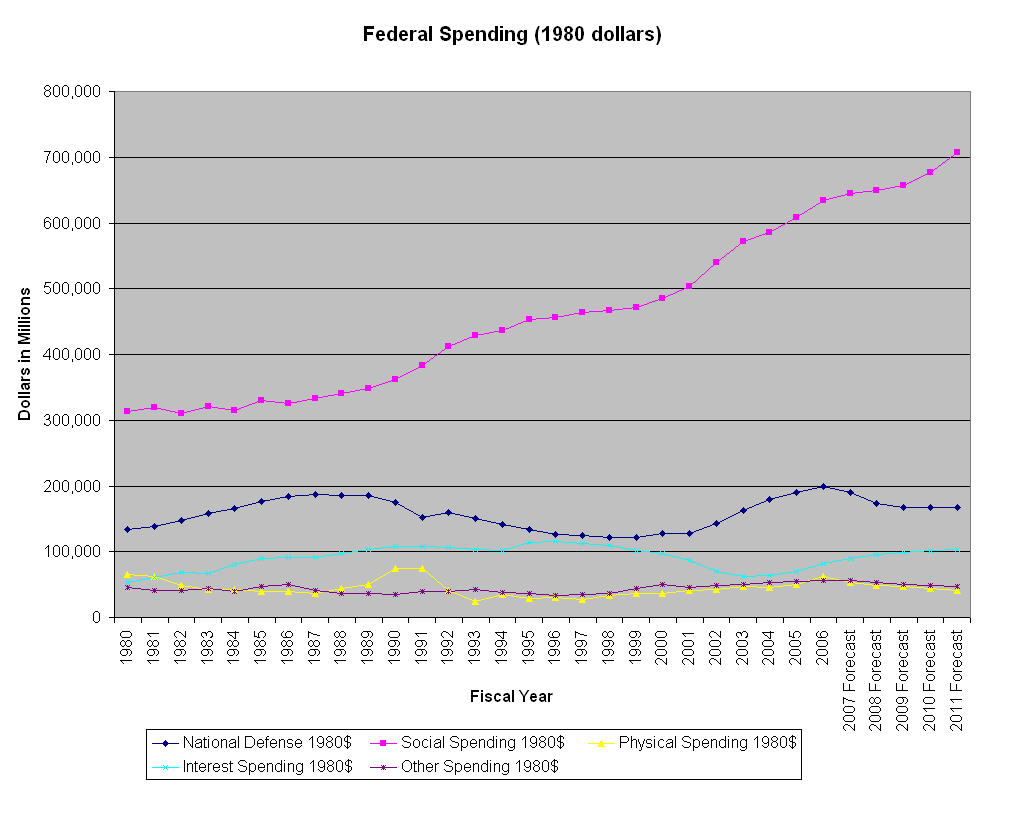 The graph above depicts United States government spending since 1980. It is adjusted for inflation and shown in 1980 dollars, so it represents the real growth of the major parts of the government:
- National Defense
- Social Spending
- Physical Spending
- Interest on the Debt
- And other spending
The National Debt currently stands at around $8.27 trilllion dollars, or about $27,500 for every man, woman and child in America. $3.47 trillion of that debt is currently held by the government in the form or Treasury securities. Of that, roughly $2 trillion is what the government alleges makes up the Social Security and Medicare trust funds. Those trust funds represent the security net for America when the boomers begin retiring and government revenues are inadequate to fund their benefits.
What would we do without those trust funds? Well, we're going to find out because they don't exist. And if we don't do something right away, another $3 trillion is going to be stolen and spent by this government only making things worse.
So what is the trust fund? Simply, it's the jar under the bed filled with the IOUs the government has put in it after it has borrowed and spent the money. Yup, the surpluses are gone. They've been spent. The government has borrowed $3.47 trillion dollars from overtaxed Americans and spent it to artificially lower annual deficits and fund unfunded spending.
Imagine that you plan to buy a car in 5 years, but you don't trust banks. You decide to put $100 a week into a jar under the bed, assuming that in 5 years you'll have $26,000 for that new car. After the first couple of months you look at that jar and see those hundred dollar bills and you have this great idea. What if you borrow the money from the jar and replace it with a $100 IOU each week. You can party, eat out, do whatever you want with the money because that jar will still have the savings for your new car in 5 years.
At the end of that 5 years, what do you have in that jar? Because you borrowed the money from yourself, you are liable to repay the jar. Basically, the money is gone! And there is the government trust fund program in a nutshell. The government has borrowed $3.47 trillion from itself and spent it. That's $2 trillion from Social Security and Medicare that is now gone.
So what will the government have in the trust fund in 2015 when entitlement outlays exceed revenues? What will the government do when there are no other surpluses to steal to fund the entitlements?
So why won't the government fix this? President Bush has proposed privatizing portions of Social Security as a start. Do people not understand what is being proposed? Bush's proposal is to invest the surpluses outside the government. By investing them somewhere outside the Treasury, whether the stock market, gold bullion, real estate, whatever, they will be invested in something that will return some, all, or more than what was invested in the future. Even if invested at a loss, there were still be something, compared to nothing as long as we continue to borrow and spend those funds as soon as collected.
So why are Democrats opposing such a basic fix to an obvious flaw in trust fund investments? The law requiring investments in Treasuries probably happened while they were in control of Congress, but can this be purely politics? Kind of a destroy our economy as long as Democrats can stay in power thing? Or maybe they just like having the surpluses to spend?
Why aren't Republicans fighting harder to reform this system before it bankrupts America? Is the thought of real cuts to adjust for the loss of the stolen trust funds too much for them too?
So back to my analogy that started this off about cracks in dams or missing sections of railroad track. If a problem can be fixed, people will almost always jump to fix it. But should we be worried that our federal government won't even try to fix this problem?
What would people do if they found that crack in the dam and it was clear that a break was iminent? What if the passenger on the train sees the missing segment of track and knows that there is no way the train can stop before derailing? In both instances those people would probably run like hell. Is that what our government is doing on the issue of entitlements today? It can't be fixed so let's just enjoy the time we have until the whole system collapses?
Whatever the reason for inaction, or downright opposition to saving America, this is not some small problem that is going to fix itself. And every day that the government does nothing, more of our trust funds are being stolen and spent.
================================================
Update: Want some ammunition to rebut liberal arguments that we spend too much on defense and not enough on children? Check this out:
Since 1980, which was the last year of Carter's decimation of America's defense, and adjusting for inflation, defense spending in 2006 is 48.5% larger than in 1980. In 2006 we are in a war against terrorism and fighting to bring democracies to Iraq and Afghanistan.
$134 billion in 1980 compared to $199 billion in 2006 (1980 dollars)
The growth of social spending, again adjusted for inflation and relative to 1980, which was near the end Carter's increases in social spending, has not only outpaced the growth of defense spending, but is more than twice the growth rate. Between 1980 and 2006, social spending in America has grown by no less than 102%.
$313 billion in 1980 compared to $634 billion in 2006 (1980 dollars)
================================================
Friday, March 17, 2006
A neighborhood's worst nightmare - Guess who's moved in next door?
Imagine that one day a nice looking guy moves into the house next door. Both intelligent and well-dressed, he invites you over for dinner and invites your two young daughters. He takes your kids upstairs to show them his daughter's room, and you leave thinking, "what a nice guy".
The next day a community meeting notice arrives, announcing the town hall to discuss the new Level 2 Sex Offender that has just moved into the neighborhood. You look at the picture, and ...
it's your new neighbor?
Sound far-fetched? It's not. It's just happened on the Eastside and the community is up in arms. Like the Lake Stevens community asking how a serial rapist could be allowed into their neighborhood, this other Eastside community is asking, "why us?" And just like that Lake Steven's community, the residents of this cul-de-sac neighborhood are discovering that the laws are not on their side either.
And to add to the strangeness of this story, this entire case has never found its way into local papers. I wonder why?
So how did it happen? How does a sex offender purchase a home without anyone knowing? Given his official trial date, it looks like the purchase was made just before he was sentenced and required to register. There's nothing in state law that required him to disclose his soon-to-be sex offender status to the real estate agent representing him, so he was in the house before anyone knew - let alone with any time to react to a pending sale. Law enforcement couldn't even react fast enough, responding only after he had moved in and registered at his new address.
But now let's get back to the neighbor with the young daughters. What could they do in a system that provides all the protections of the sex offender's rights, but not theirs? How could they guarantee the safety of their children living next door to a man that the state has classified as "likely to reoffend"?
They moved. They put their house up for sale and left. Even the local real estate companies, in desperation, offered to sell the offender's house for him at no charge to preserve housing values in the community, but he wasn't interested. He had exactly what he wanted.
And what of the future buyer of that neighbor's home? Will that buyer be protected any more than the neighborhood was? Washington State law doesn't even require the seller or the real estate agent representing the seller to disclose that their is a registered sex offender living next door. Washington State RCWs only require that the following statement be on the seller's disclosure:
And here is the political comment that having my own blog allows me to make. if you really want to make a difference, vote for people to represent you that are tough on crime, and particularly tough on criminals that would destory the lives of women and children using rape and molestation. I think it's long overdue to get tough on the criminals and not on the victims of crime in Washington. And if that means changing party control of Washington, I think that this issue by itself would be sufficient to convince me - if I still needed convincing that Democrats were corrupting Washington.
The next day a community meeting notice arrives, announcing the town hall to discuss the new Level 2 Sex Offender that has just moved into the neighborhood. You look at the picture, and ...
it's your new neighbor?
Sound far-fetched? It's not. It's just happened on the Eastside and the community is up in arms. Like the Lake Stevens community asking how a serial rapist could be allowed into their neighborhood, this other Eastside community is asking, "why us?" And just like that Lake Steven's community, the residents of this cul-de-sac neighborhood are discovering that the laws are not on their side either.
And to add to the strangeness of this story, this entire case has never found its way into local papers. I wonder why?
So how did it happen? How does a sex offender purchase a home without anyone knowing? Given his official trial date, it looks like the purchase was made just before he was sentenced and required to register. There's nothing in state law that required him to disclose his soon-to-be sex offender status to the real estate agent representing him, so he was in the house before anyone knew - let alone with any time to react to a pending sale. Law enforcement couldn't even react fast enough, responding only after he had moved in and registered at his new address.
But now let's get back to the neighbor with the young daughters. What could they do in a system that provides all the protections of the sex offender's rights, but not theirs? How could they guarantee the safety of their children living next door to a man that the state has classified as "likely to reoffend"?
They moved. They put their house up for sale and left. Even the local real estate companies, in desperation, offered to sell the offender's house for him at no charge to preserve housing values in the community, but he wasn't interested. He had exactly what he wanted.
And what of the future buyer of that neighbor's home? Will that buyer be protected any more than the neighborhood was? Washington State law doesn't even require the seller or the real estate agent representing the seller to disclose that their is a registered sex offender living next door. Washington State RCWs only require that the following statement be on the seller's disclosure:
RCW 64.06.020
Seller's duty -- Format of disclosure statement -- Minimum information.
NOTICE TO THE BUYER INFORMATION REGARDING REGISTERED SEX OFFENDERS MAY BE OBTAINED FROM LOCAL LAW ENFORCEMENT AGENCIES. THIS NOTICE IS INTENDED ONLY TO INFORM YOU OF WHERE TO OBTAIN THIS INFORMATION AND IS NOT AN INDICATION OF THE PRESENCE OF REGISTERED SEX OFFENDERS.
So one of the lessons here is don't assume that the laws or government are looking out for you. Be vigilant, because no one else is going to be. Use the resources that are available to identify the risks to your community, including sex offender websites like www.familywatchdog.us .And here is the political comment that having my own blog allows me to make. if you really want to make a difference, vote for people to represent you that are tough on crime, and particularly tough on criminals that would destory the lives of women and children using rape and molestation. I think it's long overdue to get tough on the criminals and not on the victims of crime in Washington. And if that means changing party control of Washington, I think that this issue by itself would be sufficient to convince me - if I still needed convincing that Democrats were corrupting Washington.
Thursday, March 16, 2006
Social Spending on path to Bankrupt America - Democrats answer? Don't let Bush do anything that might fix it
 Yesterday thes Federal Budget debt ceiling was raised to $9 Trillion. We've seen the National Debt grow by $2.3 Trillion since Bush took office. Democrats are foaming at the mouth at the ammunition the ceiling increase gives them against Bush, and they are continuing their unrelenting criticism of the administration's efforts to reign in out of control spending of this Republican-controlled Congress.
So how about some facts? Here is some history on Federal Spending.
Now take a look at the Pink curve in the graph above. That curve represents the growth of Social Spending in America since 1988. Socail spending includes Social Security, Medicare, Welfare, Disability Insurance, Veterans benefits, Education and other social services.
In 1998, this social spending accounted for 50 cents of every dollar of federal spending in a $1.06 tillion dollar budget. National Defense accounted for 27 cents of every dollar. In 2001, social spending had already ballooned to 64 cents of every dollar in a $1.86 trillion dollar budget, while national defense had dropped to just 16 cents out of each dollar.
After 5 years under George W. Bush, social spending has continued on its pre-Bush pace in a $2.7 trillion dollar budget, and is forecasted to reach nearly 70 cents of every federal dollar spent by 2011. Interestingly, though, for every dollar increase in defense under Bush, there has been a $2.15 increase in socail spending. And if you look at the graph, the rate of growth of that social spending was already established before Bush even took office.
While social spending is forecasted to continue its growth rate into the next decade, national defense spending has plateaued and should actually drop from this point forward.
So with these facts in hand, what has the administration done to address this domestic crisis? First, a relatively small tax cut helped get out out of the Clinton recession that started in early 2000. Unemployment is down, and the growth rate in America is healthy. But what about the out of control social spending? The data above represents actual outlays, so what happens when revenues no longer can sustain those outlays? Democrats argue that federal trust funds, now holding in excess of $3.4 trillion in Treasury securities, will come to the rescue to provide the difference between revenues and outlays. But there is the problem, and the lie. Those trust funds don't have any actual money in them. Since they were not invested in the private sector, the Treasury simply borrowed the money and it was spent on other government outlays.
In fact, all the surplus revenues to the government for decades have been spent to artificially reduce defecits and create a huge lie that there is savings to keep the social spending funded. The truth is that there is no savings, and in less than 10 years the government will not have the revenue to make its payments.
Recognizing this looming crisis, the Bush administration has attempted to reform programs like Social Security to invest its surpluses outside the Treasury so the money will be there when it needs it. As usual, though, Democrats have put politics above Americans and continue to push the lie that investing surpluses in the private sector is dangerous.
Understand that every penny of every surplus to date has been spent and is gone. When Social Security or any other trust fund program starts to cash in their Treasury securities, where is the Treasury going to get the money to repay them? The government has borrowed the surpluses from itself and spent them. There's nothing in the trust funds but a number that represents how much money the government has stolen and spent.
It's the largest financial scandal in the history of the planet, and it is continuing to be perpetrated today. $2 trillion dollars worth of Social Security and Medicare surpluses have already been stolen and spent, with trillions of dollars in surpluses yet to be collected before outlays exceed revenues. Every day that the government spends those surpluses makes things worse.
Now maybe Democrats are so selfish that they don't care what happens 10-20 years from now? Maybe retaining power today is all that matters to them, so they fignt reforms that might reduce or put off the crisis a couple more decades. Regardless of their motivations, though, what they are doing is despicable. I want my children to live in a better world than the world I live in today, but for some incredible reason, Democrats seem hell-bent on preventing any of our problems from getting solved for pure political reasons. I fear for the future.
Thursday, March 09, 2006
Quadrant buyers beware! Being the state's largest builder doesn't mean they build quality homes

I received this link today from someone involved in the litigation against Quadrant Homes for defects in their Quadrant-built homes. Check out www.quadrantdefects.com and consider what little surprises Weyerhaeuser may have left for you in your new home.
If you ask yourself how Quadrant Homes became the largest residential developer in Washington, you may find examples of government wrongdoing and bias in my blog that will help you understand the growth machine and what really makes some companies successful, and others not.
Subscribe to:
Posts (Atom)